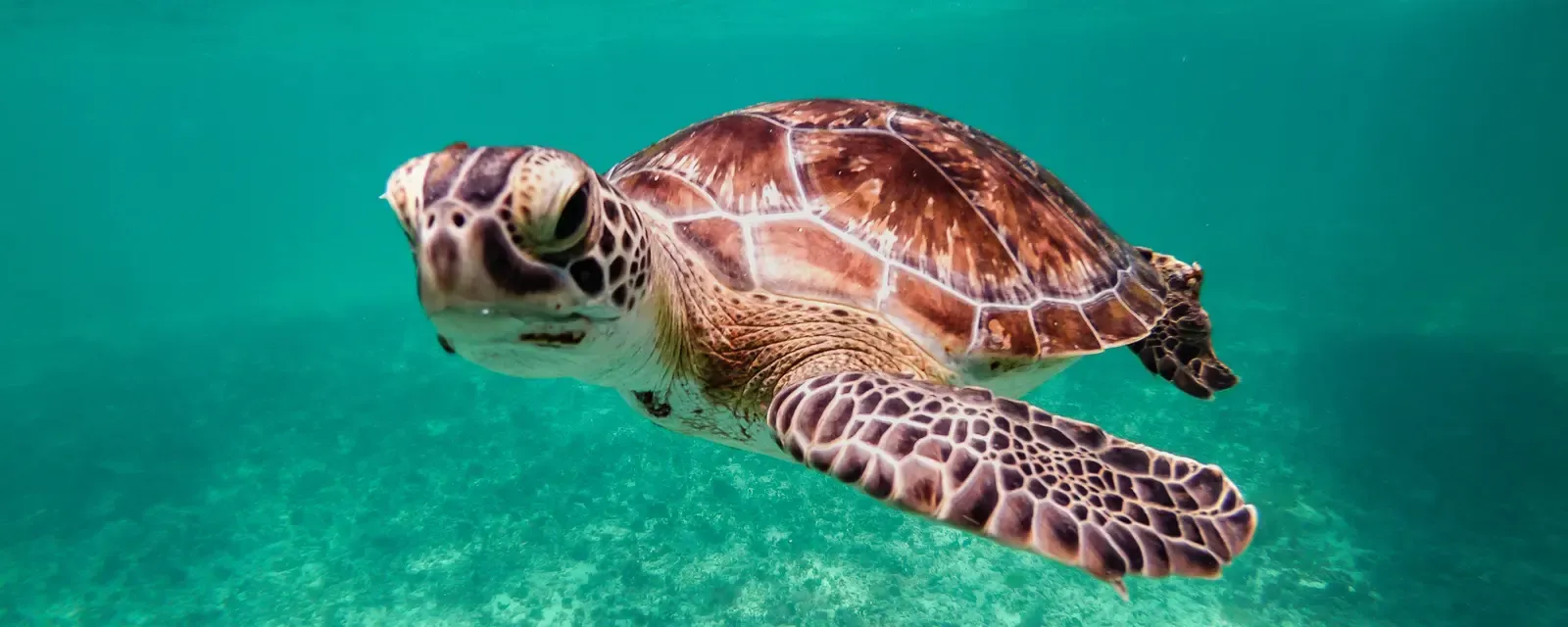
On a Flagship Aruba cruise you're going to see a lot of fish, at the SS Antilla wreck, in the shallows of Boca Catalina, along Malmok Reef. Most guests come up from the water asking the same question: “What was that?” This guide covers the species you're most likely to encounter on our tours, and the fastest way to tell them apart when you're floating above a reef with a mask full of colour.
The Aruba Advantage: Visibility Does Half the Work
Identifying fish in murky water is hard. Identifying them in Aruba is not. Water visibility on our snorkel sites regularly stays excellent, which means you get a clear, well-lit look at almost everything you encounter. There's no squinting through green water trying to make out a shape, you'll often see fish from the surface before you even get in.
That clarity is one reason Aruba's reefs are so popular with snorkelers who want to actually learn what they're looking at. It's also why so many guests on our Afternoon Snorkel Tour end up spending longer in the water than they planned.
Our crew knows these fish by name.If you spot something you can't identify, ask whoever's in the water with you, our team has been snorkeling these exact sites for years and can name almost anything you'll encounter at the Antilla or Boca Catalina.
Four Things to Look at First
When you see a fish you don't recognise, run through these four things quickly. It takes about five seconds and will narrow down almost any species to its family before the fish swims away.
1. Body Shape
Is it tall and disc-shaped? That's an angelfish, butterflyfish, or surgeonfish family. Long and thin like a stick? Trumpetfish or needlefish. Flat and diamond-shaped gliding across the sand? A stingray. Rounded and inflatable-looking? Pufferfish or balloonfish. Body shape tells you the family, colour and markings tell you the species.
2. Colour Pattern
Focus on the pattern more than the exact colour, patterns stay consistent even as fish age or change sex, and water depth can shift how colours appear. Horizontal stripes, vertical bars, solid blocks of colour, spots, each pattern is associated with specific groups. The bold black vertical stripes on a sergeant major, for example, make them unmistakable even at a distance.
3. How It Swims
Behaviour is often faster to read than colour. Parrotfish row through the water with their pectoral fins in a distinctive, almost bird-like motion. Trumpetfish hover nearly vertical, completely still, waiting to ambush prey. French grunts hover in tight, motionless clusters under ledges during the day. Once you know these behaviours, you can identify a species from ten metres away.
4. Where It Is on the Reef
Different species occupy different zones. If a large fish is resting on the sandy bottom under a coral overhang, it's likely a nurse shark or a large grouper. If something is hovering in mid-water above the wreck, it's likely a jack or barracuda. If it's nipping at coral surfaces, it's probably a parrotfish or damselfish. Location on the reef is a strong clue that most beginners overlook.
Fish You'll Almost Certainly See on a Flagship Aruba Cruise
These are the species our crew encounter on virtually every trip at the SS Antilla, at Boca Catalina, and along Malmok Reef.
- Sergeant Major(SS Antilla, Boca Catalina): small, oval-shaped, with bold black vertical stripes on a yellow-white body. You'll see them in enormous schools swirling around the upper sections of the Antilla wreck.
- French Grunt (SS Antilla): yellow diagonal stripes on a silver body. They gather in large stationary clusters under the ledges and overhangs of the Antilla during the day.
- Queen Angelfish(Boca Catalina, Malmok Reef): electric blue-yellow body, tall disc shape, and a distinctive dark “crown” marking on the forehead. Usually seen in pairs, moving slowly along coral heads.
- Parrotfish (all three sites): bright mosaic of green, blue, and pink scales, with a beak-like fused mouth used to scrape algae off coral. Their rowing fin motion makes them easy to track.
- Trumpetfish (Boca Catalina, Malmok Reef): extremely long and thin like a floating stick with a tiny mouth. Hovers vertically near sea fans and coral branches, waiting to ambush smaller fish.
- Green Moray Eel(SS Antilla): uniform green-yellow, thick, and muscular. Usually spotted with just the head poking out of a hole in the wreck, mouth opening and closing rhythmically, that's breathing, not aggression.
The Best Tip: Stop Moving
If there's one thing that separates guests who see everything from guests who see almost nothing, it's this: the best snorkelers stay still. When you fin aggressively through the water, fish scatter. When you float motionless on the surface, they come back, and within a minute or two they completely ignore you.
Find a sandy patch between coral heads at Boca Catalina, stop kicking, and just watch. The reef comes alive around you. Fish emerge from crevices. Turtles continue feeding. A trumpetfish drifts into your field of view from nowhere. It's a completely different experience from chasing things around the reef.
Sea Turtles: A Special Mention
Green and hawksbill turtles feed regularly in the sea grass beds at Boca Catalina. They're not guaranteed on every trip, but they're common enough that our crew will actively look for them when we anchor there. When you find one, the rule is simple: stay calm, keep a respectful distance, and don't touch or chase. A turtle that feels safe will keep feeding calmly and give you several minutes of extraordinary observation.
See Aruba's reef for yourself
The fish are there: the sergeant majors at the Antilla, the angelfish at Boca Catalina. Our crew will be in the water with you, naming everything you see.